
Is the Second Half of 2026 the Time to Sell Your Hotel?
Is the Second Half of 2026 Your Window to Sell?
If you own a select-service or limited-service hotel, you have probably heard some version of the same question at every industry gathering this year: is it finally time to sell? For most of the past three years, the honest answer was “not unless you have to.” Bid-ask spreads were wide, debt was expensive, and buyers and sellers rarely agreed on a property’s value.
The second half of 2026 looks different. Deal volume is climbing, lenders are competing again, and the analysts who track hotel pricing expect more sellers to meet the market before year-end. None of that guarantees this is your window — but for the first time in a while, the question deserves a serious answer. Here is what the data says, and how to apply it to your property.
The Market Has Moved — in Sellers’ Favor
The transaction market was frozen for most of 2023 and 2024. It is thawing in stages. JLL reports that U.S. hotel transaction volume rose 14.4% year over year in the first quarter of 2026, to $5.6 billion, and its 2026 outlook calls for larger deals to keep increasing as debt markets improve. HVS tracked another 9.1% increase in dollar volume from the first quarter to the second.
More telling than the volume is the mood. Lenders who spent two years extending loans and “kicking the can” are increasingly ready to see assets trade, and hotel values are firming on the sell side. HVS’s August 2026 U.S. Market Pulse expects a shift in seller expectations in the second half of the year: more owners accepting today’s pricing rather than waiting for a meaningfully better market that may not arrive, especially with inflation keeping pressure on interest rates.
In plain terms: the gap between what buyers will pay and what sellers will take — the thing that killed most deals since 2022 — is finally narrowing.
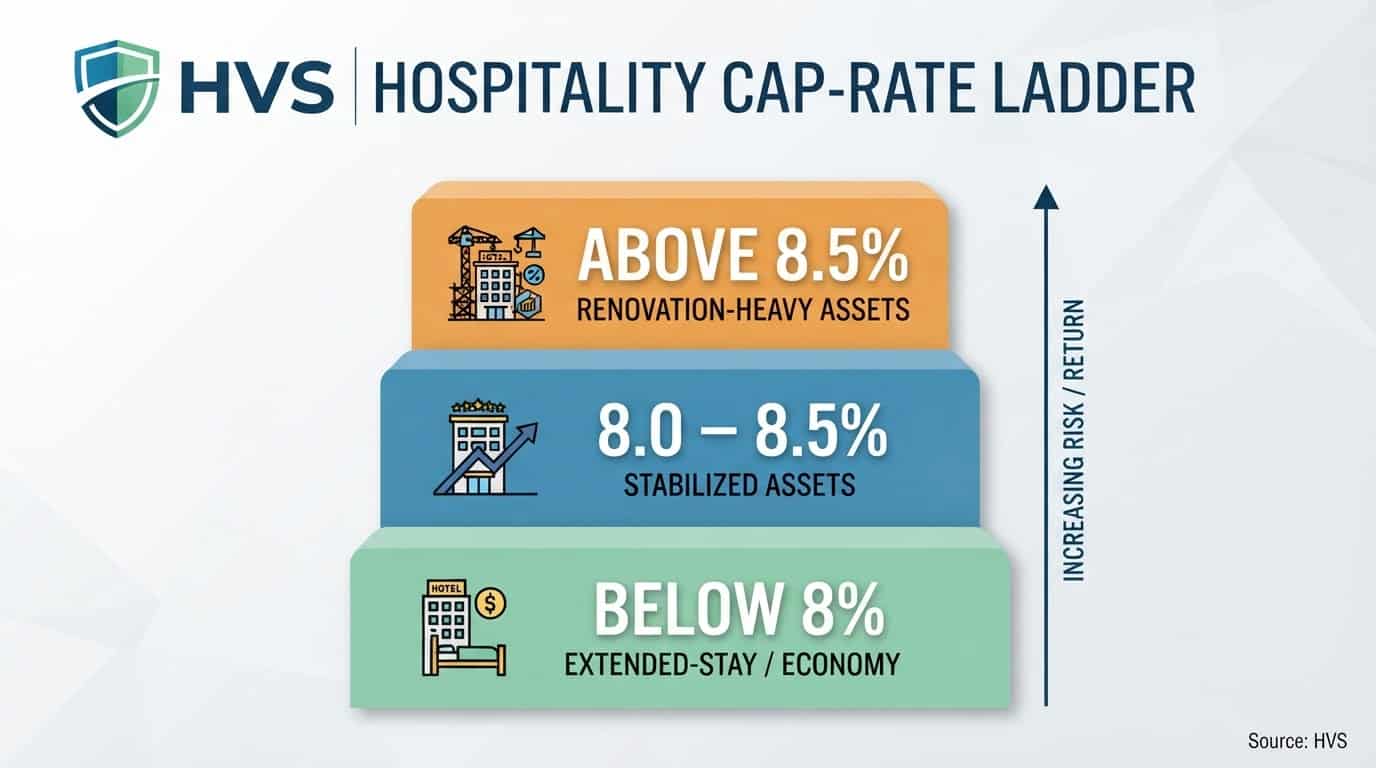
For a stabilized or near-stabilized hotel, HVS pegs today’s typical cap rate at roughly 8.0% to 8.5%, with exit cap rates about 100 basis points higher. Economy, extended-stay, and luxury assets tend to price below that range. Older limited- and select-service hotels facing a major renovation tend to price above it.
That last sentence is the one to sit with. The spread between a “clean” hotel and a “needs work” hotel is as wide as it has been in years. A property with a completed or manageable PIP, a healthy franchise term, and strong trailing-twelve-month numbers commands a premium.
A comparable property carrying a deferred renovation gets discounted twice — once for the renovation cost, and again for the risk and hassle. If a change-of-ownership PIP is looming over your asset, our earlier piece on key money and brand switching covers ways to protect value before you ever go to market.
One more pattern worth knowing: institutional capital is crowding into the top of the market. PwC’s mid-year deals outlook found that upscale, upper-upscale, and luxury properties accounted for 73% of hotel deals over the past six months — the highest concentration in two years.
For a midscale or economy hotel in a secondary market, that means your most likely buyer is an owner-operator financing the purchase with SBA or bank debt, which brings us to the third leg of the story.
Financing Is Working Again — and That Deepens Your Buyer Pool
Sellers sometimes forget that their sale price is set in someone else’s loan underwriting. When debt is scarce and expensive, buyers can’t stretch. In 2026, that constraint is easing: industry lender surveys show banks, SBA lenders, CMBS conduits, and debt funds all active in hotel lending again, with permanent-loan rates for quality deals starting in the 6% to 7% range and leverage commonly in the 55% to 65% band.
For the sub-$10 million deals that make up most owner-operator transactions, SBA financing remains the workhorse — and every point a buyer saves on interest is room in their underwriting to pay more for your hotel. If you expect your eventual buyer to go that route, our guide to navigating the SBA loan process is worth forwarding; deals close faster when both sides understand the timeline.
The Case for Waiting — and What It Costs
To be fair to the other side of the argument: rates could ease further, your NOI may still be growing, and nobody rings a bell at the top. Holding is a legitimate strategy for owners with fresh renovations, long franchise terms, and no personal timeline.
But waiting is not free, and in 2026 it carries three specific costs:
- Your trailing twelve months may never look better. HVS expects ADR growth to moderate in 2027 as the one-time lift from the 2026 World Cup and a heavy events calendar fades. Buyers underwrite the trailing numbers in front of them — and right now those numbers show the best version of many markets.
- The PIP clock keeps running. Renovation obligations get bigger and more expensive with time, and they transfer straight into your sale price.
- You may be listing into a crowd. If HVS is right that more sellers meet the market in the second half of 2026, owners who move early face less competing inventory than those who wait for confirmation.
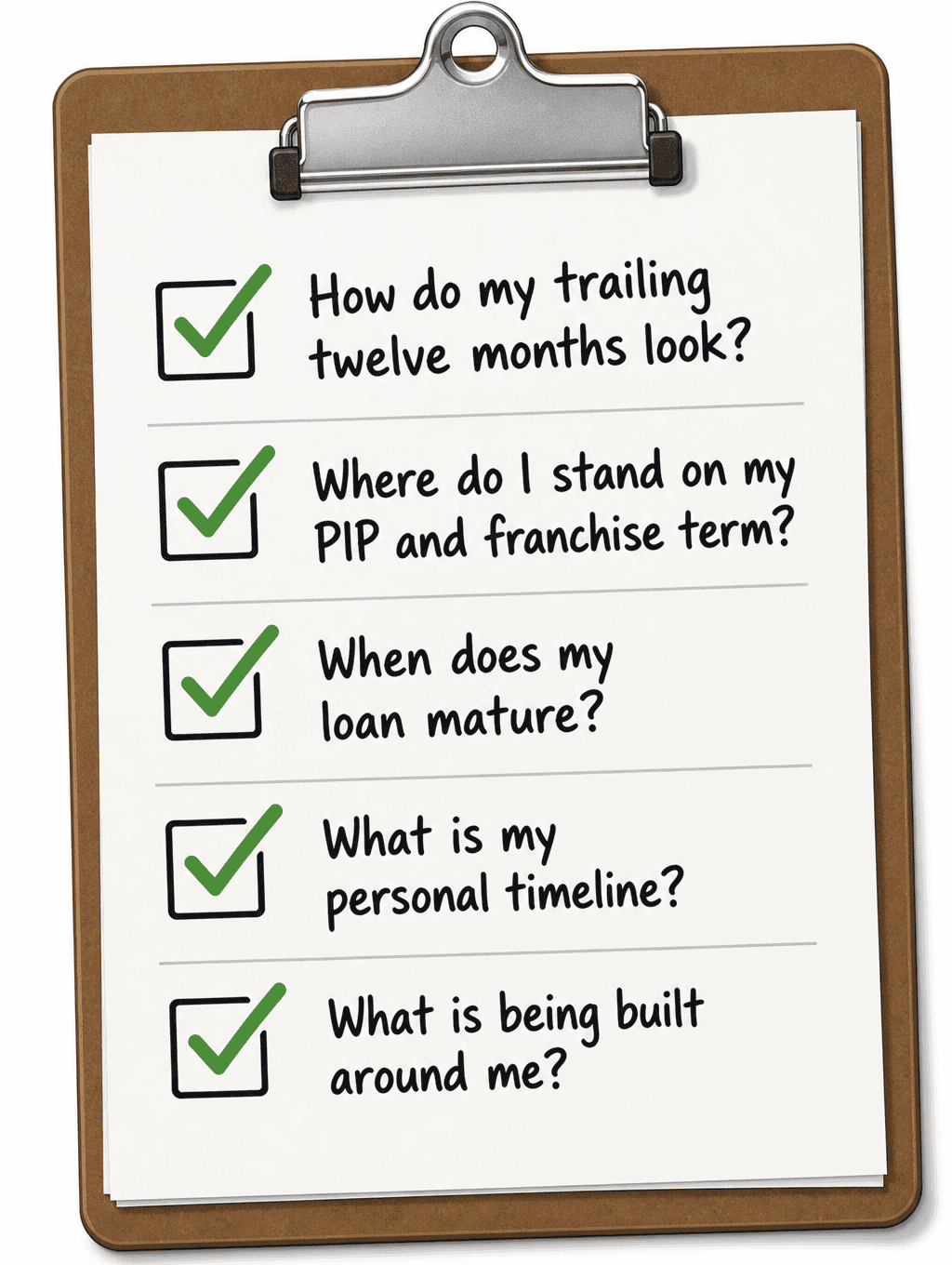
Market timing matters less than property timing. Ask yourself:
- How do my trailing twelve months look? If this is your strongest 12-month stretch in years, buyers can see — and will pay for — that trend.
- Where do I stand on my PIP and franchise term? A current PIP and several years of term is a selling asset. A looming change-of-ownership PIP means the renovate-reflag-or-sell decision should be made deliberately, not by default.
- When does my loan mature? If you face a maturity in the next 18 to 24 months, compare a refinance at today’s rates against a sale at today’s pricing before the calendar decides for you.
- What is my personal timeline? Retirement, succession, or estate planning on the horizon makes a firm market a gift. The worst time to sell is when circumstances force it.
- What is being built around me? New supply pipelines are historically thin in most U.S. markets, which supports existing hotel values — but check your own submarket before assuming you’re protected.
The Bottom Line
The second half of 2026 offers something hotel sellers haven’t had in several years: rising deal volume, functioning debt markets, firming values, and analysts openly expecting sellers and buyers to find common ground.
The window argument is strongest for owners with clean recent numbers, a manageable PIP, and a personal reason to act within the next couple of years.
If that sounds like you, the first step isn’t a listing — it’s a number. Mumford Company has advised hotel owners on buying and selling since 1978, and a confidential broker opinion of value costs nothing but a conversation.
Contact your nearest regional office to start one. And if you’re not ready yet, our Mumford Company weekly newsletter will keep new listings, price reductions, and market notes in front of you until you are.
Frequently Asked Questions
Should I wait for interest rates to drop before selling my hotel?
Lower rates would help buyers stretch, but analysts expect inflation to keep rates from falling quickly, and waiting has costs of its own: renovation obligations grow, the 2026 events-driven revenue bump fades from your trailing numbers, and more sellers are expected to list as the year closes. If your operating numbers and franchise position are strong today, waiting is a bet, not a plan.
What cap rate should I expect for a select-service hotel in 2026?
HVS places stabilized and near-stabilized hotels at roughly an 8.0% to 8.5% cap rate, with extended-stay and economy assets often below that range and older properties facing major renovations above it. Your specific number depends on RevPAR performance against your comp set, PIP status, remaining franchise term, and market conditions — which is what a broker opinion of value establishes.
How long does it take to sell a hotel?
Most hotel sales run several months from listing to closing once you account for confidential marketing, buyer due diligence, financing, and franchisor transfer approval. Owners hoping to close in 2027 should be having valuation conversations in 2026.
Do I have to tell my franchise brand I’m selling?
Eventually, yes — a franchised hotel sale requires the brand’s transfer approval and usually triggers a change-of-ownership PIP. But the sequencing is manageable. An experienced hotel brokerage controls when the franchisor, your staff, and your guests learn about the sale so that none of them learns at the wrong time.
